
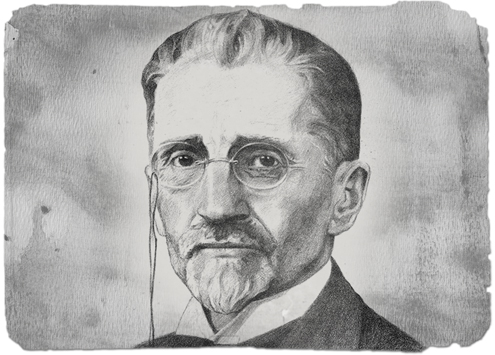
Eliezer Ben-Yehuda (1858–1922) was a pioneer in the revival of spoken Hebrew who used the popular media of his time – newspapers – to bring his ideology and innovations to the general public. In addition, he helped found the Language Committee and composed the largest and most comprehensive Hebrew dictionary of his era (A Complete Dictionary of Ancient and Modern Hebrew, 1908–1959), a work that aimed to record the vocabulary of Hebrew from all periods. Ben-Yehuda’s work continues in spirit at the Academy of the Hebrew Language in the Historical Dictionary Project.
- Young Ben-Yehuda
- Ben-Yehuda and Hebrew Journalism
- Ben-Yehuda and the Language Committee
- Innovations in Hebrew and the Dictionary
- Eliezer Ben-Yehuda Memorial
- Israel’s Mother Tongue Has a Father (A Film by ICEJ-Germany)
Young Ben-Yehuda
Ben-Yehuda was born Eliezer Yitsẖak Perlman on January 7, 1858, in the town of Luzhki (then part of the Vilna Governorate in the northwest region of Imperial Russia and today in northern Belarus). His early education was in a heder, a traditional Jewish school for young boys. In 1871, after becoming bar-mitzva, Ben-Yehuda was sent to his uncle in Polotsk to study in a yeshiva, or traditional Talmudic academy. The head of the yeshiva, Rabbi Yosi Bloyker, who secretly was part of the Haskala (Jewish Enlightenment movement), introduced the teen to Hebrew grammar (at the time, a forbidden topic of study in yeshiva) and to Enlightenment literature. Eliezer developed a passion for Hebrew; and as his Jewish nationalism deepened, so did his conviction that reviving Hebrew as a spoken language was essential – and he dedicated himself to the project. In 1881, he and his fiancée, Devora Jonas, moved to the Land of Israel, marrying en route. They settled in Jerusalem and resolved to speak only Hebrew to anyone who knew the language.
Ben-Yehuda and Hebrew Journalism
Ben-Yehuda began his journalism career in the Holy Land at the newspaper Habazeleth (חבצלת, pronounced ẖavatselet), owned by Yisra'el Dov Frumkin. He continued working there until the end of 1884. While working with Frumkin, Ben-Yehuda also published his first newspaper, מבשרת ציון (pronounced mevasseret tsiyon), which appeared as an insert to Habazeleth in 1884. After leaving Habazeleth, Ben-Yehuda launched his first independent newspaper, Hazewi (הַצְּבִי, pronounced hatsevi or hatsvi), in October 1884.
Ben-Yehuda worked in journalism for 30 years, until shortly after the beginning of World War I. He used his newspaper as a tool for the dispersion of his ideologies concerning the revival of the Jewish nation – including criticism of Jerusalem’s Old Yishuv (long-time Jewish community) and of its dependence on ẖalukka (charity from diaspora Jews) – and also as a means of publicizing his Hebrew neologisms.
Ben-Yehuda’s struggle and his attempts to create a free press met with an angry response from the Turkish government, which occasionally shut down his papers. By H̱anukka of 1893, the Turks even censored the papers for a short period. To continue publication, Ben-Yehuda was forced to engage in subterfuge and to change the name of his publications.
Ben-Yehuda and the Language Committee
Ben-Yehuda’s work extended beyond journalism. In 1882 he established, with Rabbi Yeẖi'el Mikhl Pines, Hevrat Teẖiyat Yisra'el (the Society for the Rejuvenation of Israel), which focused on the revitalization of the Nation of Israel in the Land of Israel, including the revival of spoken Hebrew.
After almost eight years, in September 1889, Ben-Yehuda founded Safa Brura with Rabbi Ya’akov Meir (the sometime Rishon LeTsiyon), Rabbi Haim Hirshenson, and Rabbi Haim Kalami. The organization’s goal was the “instilling in all the residents of our ancestral land one clear language, the tongue of our early ancestors, which is of upmost sacristy,” as was written in a letter by the leadership in 1889.
A few months later, at the end of 1890, Safa Brura founded the Literature Committee. Ben-Yehuda was chosen as president, and with him served Rabbi Haim Hirshenson, David Yellin, Ze’ev Ya’vets, Avraham Moshe Lunts, Rabbi Ya’akov Meir, and Yeẖi'el Mikhl Pines. Shortly thereafter, the committee changed its name to Va’ad HaLashon (the Language Committee), which existed until 1891. In 1904, the committee renewed its efforts, and after the establishment of the State of Israel, it served as the basis for the foundation of the Academy of the Hebrew Language.
Innovations in Hebrew and the Dictionary
Ben-Yehuda was first taken by the idea of the revitalization of the Hebrew language while living in Paris. He spoke about the lack of Hebrew jargon for foreign concepts and began to renew Hebrew words to fill the vacuum. Appropriately, the first word Ben-Yehuda created was “millon” for dictionary, which replaced the construction “sefer millim” (a book of words) which had been used until then as a translation of the German “Woerterbuch.” Additionally, Ben-Yehuda began to list words from Hebrew literature of all periods as a basis for an overarching Hebrew dictionary.
After three unsuccessful publication attempts (in 1887, 1895, and 1900-1905) his dictionary, the Complete Dictionary of Ancient and Modern Hebrew, began to be published in Berlin in 1908. The dictionary was published in stages from 1908-1959, and was planned for 16 volumes, with an additional introductory volume. Five volumes were published before the start of World War I, and these were the only ones Ben-Yehuda saw before his death on December 16, 1922.
Ben-Yehuda did edit the sixth and seventh volumes prior to his death, which were printed posthumously. The eighth and ninth volumes were edited by Moshe Tsvi Segal, who was Professor of Bible and Semitic linguistics at The Hebrew University in Jerusalem. The remaining volumes, including the introduction, were edited by Naftali Hertz Tur-Sinai (né Harry Torczyner), who was Professor of Hebrew Language at the Hebrew University in Jerusalem and the President of the Language Committee, and later the first President of the Academy of the Hebrew Language.
Ben-Yehuda also published a pocket Hebrew-Yiddish-Russian dictionary in 1901 and a larger Russian-Hebrew-Yiddish dictionary with Yehuda Grazovsky in 1907.
Among the many hundreds of words Ben-Yehuda is credited with creating are “bubba” (doll), “glida” (ice cream), “zehut” (identity), “havita” (omelet), “haydak” (bacteria), and “rishmi” (official).
Eliezer Ben-Yehuda Memorial
The Eliezer Ben-Yehuda Memorial at the Academy of the Hebrew Language was first opened in 1973. On display is a selection of furniture, books, artwork, and tools from the dictionary research from Ben-Yehuda’s home in Jerusalem, which was donated by the family to the Academy.
The books from Ben-Yehuda’s library represent his world, the world of an enlightened Eastern European Jew transplanted to the Holy Land. Among them are sacred Jewish texts, many Hebrew dictionaries in various languages, encyclopedias from the turn of the 19th century, and more.
In 2008, upon the 150th Anniversary of Ben-Yehuda’s birth, UNESCO honored the linguist and his life’s work as an outstanding contribution to education, science, and culture.