
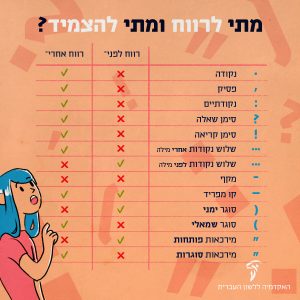
The punctuation signs used in Modern Hebrew are the same ones found in European languages. However, their use initially varied widely by writer, in some cases hewing to German and Russian norms, in other cases following English and French practice.
In the early 1940s, after several years of discussions, our predecessor, the Language Committee, adopted punctuation rules. They reflected heavy Central and Eastern European influence, with commas serving many different functions and setting off some syntactic units that would not be demarcated in standard English punctuation (e.g., restrictive relative clauses and content clauses). Because of Hebrew’s compact structure, the rules resulted in a very high ratio of punctuation marks to words. In time, writers of Hebrew grew very displeased with the rules, particularly because of the thicket of punctuation marks required and the attendant disruption to the flow of reading. The Academy therefore formed a committee in 1984 to compose new punctuation rules. The new rules were discussed in the plenum in 1991–1992, ratified in December 1992, and published in 1993.
The Academy’s rules shift Hebrew punctuation toward English norms and encourage a more sparing use of commas; no less importantly, they grant the writer greater liberty and discretion. For instance, the use of punctuation marks to express emotion is treated as a stylistic matter left to the writer. Furthermore, the introduction to the rules states explicitly that the rules are not entirely hard and fast but in many cases were formulated to leave room for the writer to exercise judgment, especially regarding the use of commas. Indeed, some rules present conditions in which the punctuation mark is or may be used, rather than prescribing its use. Nevertheless, the introduction to the section on the comma does take a clear stand, advocating against an overabundance of commas, especially where the structure of the sentence is apparent from structural words (conjunctions and such), and particularly between short units.
Learn more (in Hebrew):