

The Academy is the premier institution for research of the Hebrew language; our primary enterprise is the Historical Dictionary Project (HDP), formally established in the 1950s. The overarching goal of the HDP is to present the history and development of the Hebrew lexicon, tracking words through shifts in form, meaning, and frequency of usage from their earliest attestations in the sources until their most recent documentation, up to the mid-20th century.
A historical dictionary necessarily requires a large textual database; but while historical dictionaries of European languages make do with select quotations from previous centuries, the HDP set the ambitious goal of creating a computerized database containing all extant post-Biblical Hebrew texts composed up to 1050 CE and a large selection of Hebrew works since then, up to the founding of the State of Israel, spanning more than 2000 years of Hebrew writing. (From the beginning, the HDP intended not only to produce a dictionary, but also to create an archive of the Hebrew language.) To manage the tremendous amount of data and optimize access to the texts and to the information our researchers recorded about them, the HDP was among the world pioneers in harnessing modern technology to create a computerized concordance. This concordance has grown into a vast treasure trove, an incredible research tool in its own right. We have made the database available to the public on the Ma'agarim website, which supports sophisticated textual searches by word, phrase, or root, as well as browsing of entire compositions.
Background and Early Days of the HDP
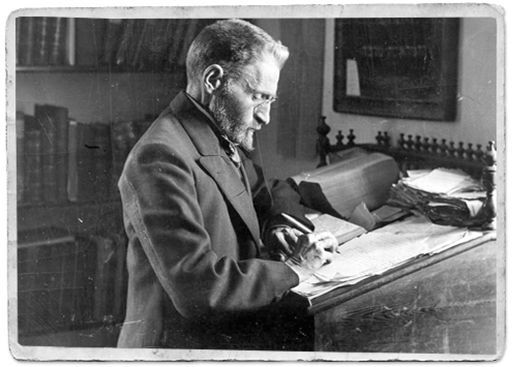
Credit for the first historical dictionary bringing together Hebrew from different periods (A Complete Dictionary of Ancient and Modern Hebrew, 1908–1959) belongs to journalist and Hebrew scholar Eliezer Ben-Yehuda (1858–1922), shown here at work in his study (at right; courtesy of the Central Zionist Archives). However, one person could not truly complete such a monumental task alone: he died before finishing his dictionary, and the latter volumes were written or edited by others.

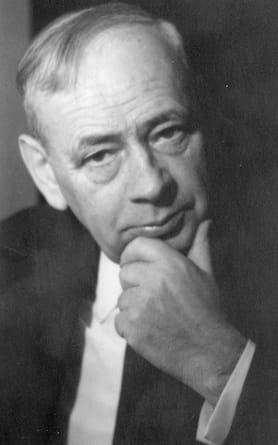
As early as 1937, Prof. N. H. Tur-Sinai (pictured at right), then president of the Language Committee and later the first president of the Academy, proposed the establishment of “a large enterprise for the preparation of an academic dictionary of our language, encompassing all its periods and all the transformations that it has undergone from its earliest historical documentation to the present day.” Upon the founding of the Academy in 1953, we decided to pursue this colossal project as our central undertaking.
Prof. Ze’ev Ben-Ḥayyim (at right) helped found the HDP and served as the first editor-in-chief (1956–1992). He spent the beginning of his term developing the vision and methodology for such a large undertaking. While on a six-month research stint in Europe in 1957–1958, he visited historical-dictionary projects in several countries. Upon his return, he reported on what he’d learned to the HDP editorial board and proposed a plan of action, including the use of computers, a revolutionary idea at the time.
After some initial debate about whether to produce a series of dictionaries (e.g., by period or by literary genre) or a single comprehensive dictionary, in 1959 the HDP editorial board accepted Prof. Ben-Ḥayyim’s recommendation to pursue the latter. The HDP staff began by compiling a catalog of Hebrew texts, recording the particulars of each composition, including the extant manuscripts of it.
Methodology
Manuscripts of ancient texts provide a much more accurate view of the language than do printed editions. Working with manuscripts, including small fragments found in the Cairo Geniza, demands considerable time and effort but rewards the extra investment with invaluable linguistic information. If there are multiple extant manuscripts of a composition, the HDP selects the best and most complete one available. Thanks to this reliance upon superior manuscripts, the texts in the HDP database often differ from standard printed editions, sometimes containing a rare or unexpected word that may appear to be an error but is actually an authentic earlier version of the text.
The HDP’s researchers process each text in two stages: first they transcribe it and add markups; then they analyze each word grammatically, assign it to a concordance entry, and, if appropriate, add tags. At each stage, two additional HDP researchers review the work of the first one.
The processing of texts began with post-Biblical ancient literature (200 BCE–1100 CE) and then moved on to modern literature (since 1750). In the 21st century the HDP began processing medieval literature and added the Bible to the database. The HDP incorporates not only “literature” in the strict sense: for instance, the ancient texts include inscriptions on coins, tombstones, and such.
Ancient Literature
The Historical Dictionary Project has completed the processing of the Bible and all available post-Biblical Hebrew texts through the end of the Geonic period (up to 1050 CE), using the best manuscript witnesses from library holdings worldwide (for the ancient period, the original manuscripts are rarely extant). The material includes the Talmud, midrash, liturgy, poetry, Karaite literature, and Geonic texts, as well as ancient inscriptions and the Judean Desert scrolls.
With the notable exception of the Judean Desert Scrolls, most ancient texts have reached us in late copies. In the process of being copied again and again – in some cases hundreds of times – they accumulated many mistakes, especially when copyists corrected the text without fully understanding the language of the original: though the copyists intended to fix or improve the text, they instead corrupted it. The Historical Dictionary Project consults with experts and seeks the best transmission of each composition. Still, the most faithful witnesses to ancient Hebrew come from archeological finds that preserve the original text, unmediated by copyists: tombstones, synagogue dedications, coins, and seal impressions. The HDP includes such texts as well.
Medieval Literature
The first several decades of the HDP’s work focused primarily on collection and analysis of ancient and Haskala literature, leaving a gap of some seven centuries (approximately 1050–1750 CE). This intermediate period saw the widest geographical distribution of Jewish cultural centers, and the diversity of Hebrew texts from the period reflects the extent of the dispersion. Because of the great scope and variety of the most significant literature, the HDP will analyze only a portion of the extant medieval compositions. Rabbinic works (1050–1550 CE) and poetry of Spanish Jews were among the first texts analyzed from the medieval period.
Prose
Rabbinic texts constitute the most prolific genre of Hebrew writing from the 11th to the 16th century, heavily influencing future generations. In 2009 the HDP began working on this body of literature, compiling a catalog of selected texts before starting to process them. The chosen sources encompass halakhic, exegetical, and homiletical works from a range of traditions and times. The HDP has since begun processing and analyzing medieval Hebrew translations of Arabic compositions (e.g., Judah HaLevi’s Kuzari and Maimonides’s Guide for the Perplexed), as well as scientific tracts and additional literary genres composed in Hebrew.
Poetry
Spanish Jewish poetry (both religious and secular), preserved by the Spanish Jewish exiles, was regarded by many in the Jewish and non-Jewish world alike as the pinnacle of Hebrew poetry. Accordingly, it influenced other centers of Hebrew poetry – Yemen, Italy, and Ashkenaz. The HDP has already processed the poetry of the early Spanish Jewish poets (such as Dunash ben Labrat, Menaẖem ben Saruk, and their disciples) and has begun processing that of the “Golden Age” in Spain (11th–12th centuries), including works by the three outstanding poets of the day – Samuel HaNagid, Solomon ibn Gabirol, and Judah HaLevi.
Modern Literature
In 1969 the HDP began processing Modern Hebrew compositions, on the whole according to the first printed edition of each work. Initially the corpus ranged from the Haskala in Germany (mid-18th century) to the 1930s; in 2009 its scope was extended backward to include literature composed in Italy and Amsterdam from 1500 onward. From this corpus the HDP has processed over 600 works of varying length by some 100 writers – over 11 million words of text – and assigned concordance entries to about one-third of the compositions.
Modern Hebrew writing constitutes an important building block in the formation of today’s spoken Hebrew. Composed in a modern European cultural, material, and intellectual setting, the Hebrew writing of this period reflects a conscious adaptation to the ambient culture and therefore abounds with new genres of Hebrew composition, including belles-lettres, travelog, autobiography, and journalism; the period also supplies a wealth of scientific literature in Hebrew. In all these genres we find new words, phrases, and meanings that remain in use to this day. The processes sparked by the printing revolution – processes that continued with the creation of Mendele Mokher Sforim’s style and culminated in the revival of Hebrew speech – renewed and secularized the language, laying the foundations for the Hebrew of our day.
Because of the tremendous amount of material from this period, the HDP will restrict itself to selections from each genre, including works by Aẖad Ha'Am, Yosef H̱ayyim Brenner, Y. D. Berkowitz, Uri Nisan Gnessin, H̱ayyim Hazaz, Ze'ev Jabotinsky, Avraham Mapu, Moses Mendelssohn, Perets Smolenskin, and Rabbi Moses H̱ayyim Luzzatto. However, for three of the most eminent writers the HDP decided to make an exception and include their entire oeuvre: Mendele Mokher Sforim, H̱ayyim Naẖman Bialik, and Shmuel Yosef Agnon.